Choosing the right typography for a corporate law firm goes beyond picking letters that look nice. It is about balancing tradition with modern efficiency. When you pair a classic serif typeface with a clean sans-serif, you signal to clients that your firm respects legal precedent while operating with contemporary sharpness. Getting these corporate law firm branding serif and sans serif combinations right ensures your visual identity looks authoritative on everything from letterheads to digital contracts.
Why do corporate law firms mix serif and sans-serif fonts?
Mixing these two styles creates visual contrast and establishes a clear hierarchy in your legal brand guidelines. Serif fonts, with their small decorative strokes, carry a sense of history, prestige, and reliability. Sans-serif fonts feel direct, accessible, and highly readable on screens. By assigning a serif to your headings or logo and a sans-serif to your body text, you guide the reader's eye naturally through complex legal documents and website pages.
What are the best font pairings for a corporate legal practice?
A strong pairing relies on contrast in style but harmony in proportion. Here are three reliable combinations used in modern legal branding:
- Playfair Display and Lato: Playfair Display offers high contrast and an elegant, editorial feel for headlines. Pairing it with Lato keeps the body text friendly and highly legible on digital devices.
- Garamond and Open Sans: Garamond is a staple in legal publishing because of its classic, scholarly tone. When matched with Open Sans for web interfaces, it bridges the gap between traditional print briefs and modern client portals.
- Merriweather and Roboto: Merriweather was designed specifically for screen readability, making it an excellent choice for a firm's digital presence, while Roboto provides a mechanical, structured feel for user interface elements.
How do you assign fonts across your law firm's visual identity?
Once you select your typefaces, you need strict rules for where they appear. When you are matching typefaces for your logo and website, reserve the serif font for your firm's name, main headings, and pull quotes. Use the sans-serif font for navigation menus, body paragraphs, and footer text. This approach prevents visual clutter. If you need more guidance on choosing authoritative typography for your brand identity, focus on limiting your entire brand to just two primary font families. You can also explore specific serif and sans-serif combinations for corporate firms to see how top practices structure their brand guidelines.
What mistakes should legal marketers avoid when pairing fonts?
The most common error is picking two fonts that look too similar. Pairing a serif with a slightly different serif, or two sans-serifs with the same x-height, creates visual confusion rather than contrast. The reader's brain struggles to tell the heading apart from the body text.
Another frequent mistake is using overly decorative or script fonts to stand out. Corporate law requires a serious tone. Decorative fonts can make a firm look like a boutique event planner rather than a corporate litigation team. Stick to transitional or modern serifs and geometric or humanist sans-serifs.
Finally, avoid ignoring line height and letter spacing. A beautiful typeface pairing will fail if the body text is cramped. Legal documents contain dense information, so give your sans-serif body copy plenty of breathing room with a line height of at least 1.5.
How can you test your typography before launching?
Do not finalize your brand guidelines based on how the fonts look in a design software preview. You need to see them in actual use. Print a mock client advisory on standard letter paper to check the serif headings and sans-serif body text in physical form. Then, view the same document on a mobile phone to ensure the sans-serif remains legible at smaller sizes.
Next steps for finalizing your legal typography
- Audit your current website and print materials to identify how many different fonts are currently in use.
- Select one primary serif for headings and one primary sans-serif for body text.
- Define exact font weights, such as Regular, Semi-Bold, and Bold, to prevent designers from using too many variations.
- Create a one-page typography cheat sheet for your marketing team and external vendors.
- Test the chosen pairing on both a printed brief and a mobile screen before updating your official brand book.
 Selecting Authoritative Fonts for Legal Brands
 Font Pairings That Build Trust for Attorney Sites
 Mastering Font Pairings for Law Firm Branding
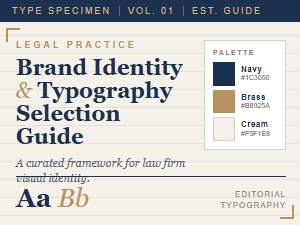 Font Selections for Law Firm Branding
 Researching Classic Script Fonts for Attorney Logos
 A Professional Guide to Classic Script Fonts for Law Firms